

Introduction
Understanding stock market trends is crucial for anyone looking to grow their wealth through investing. The stock market can appear complicated, especially for beginners, but learning to read trends can make investing more manageable and rewarding. Stock market trends show the direction in which stock prices are moving over a period, helping investors make informed decisions. Whether you are a beginner or an intermediate investor, knowing these trends can reduce risks and increase your chances of profitable outcomes.
In this guide, we will explore what stock market trends are, why they are important, and how you can use them to your advantage. We will also cover the benefits, risks, common mistakes, and expert tips to help you become a confident investor. By the end of this article, you will have a clear understanding of stock market trends and how to use them for smarter investing.
Investing without understanding trends is like sailing without a compass. Trends provide direction and insight into market behavior. For example, a rising trend indicates increasing stock prices, which can be an opportunity for buying or holding investments. Conversely, a falling trend may signal caution or potential selling. Learning to identify these patterns is the first step toward becoming a successful investor.
With patience and the right knowledge, stock market trends can transform your investing experience. Whether your goal is long-term wealth or short-term gains, understanding trends equips you with the tools to make smarter financial decisions. Let’s dive deeper into what stock market trends are and why they matter.
What is Stock Market Trends?
Stock market trends are patterns in the movement of stock prices over time. They indicate the overall direction of the market or a particular stock. In simple terms, trends show whether prices are generally rising, falling, or moving sideways. Understanding these trends helps investors predict potential market behavior.
There are three main types of stock market trends:
- Uptrend – This occurs when stock prices consistently rise over a period. Investors often see this as a buying opportunity.
- Downtrend – This happens when prices steadily decline. It can signal the need to sell or avoid investing in certain stocks.
- Sideways Trend (Range-bound) – Prices move within a narrow range, neither rising nor falling significantly. Investors may wait for a breakout before making decisions.
Trends can also be short-term, medium-term, or long-term:
- Short-term trends last from a few days to a few weeks and are often influenced by market news or events.
- Medium-term trends span several weeks to months and reflect broader market movements.
- Long-term trends last years and are influenced by economic cycles, business growth, and global events.
By identifying these trends, investors can make more informed choices about when to buy, hold, or sell stocks. Trend analysis is a core part of technical analysis, which focuses on historical price movements to forecast future behavior. While trends do not guarantee outcomes, they provide valuable guidance.
Why is Stock Market Trends Important?

Understanding stock market trends is essential for several reasons:
- Informed Decision-Making – Trends provide insights into market direction, helping investors decide when to buy or sell.
- Risk Reduction – By recognizing patterns, investors can avoid poor investments or reduce losses during downtrends.
- Timing Investments – Knowing the trend allows investors to enter or exit positions at optimal times.
- Market Sentiment Insight – Trends reflect investor confidence and market sentiment, which can influence future price movements.
- Strategy Development – Long-term investors can align their strategies with trends to maximize returns.
Ignoring trends often leads to emotional investing, where decisions are based on fear or greed. Trends help remove emotions from investing, making it more systematic and disciplined. Even beginners can benefit from understanding basic trend patterns before diving into more advanced strategies.
Detailed Step-by-Step Guide to Understanding Stock Market Trends
Investing in the stock market requires a structured approach. Here’s a step-by-step guide to help you understand and use stock market trends effectively.
Step 1: Learn Basic Market Terminology
Before analyzing trends, familiarize yourself with basic terms:
- Bull Market: A period of rising stock prices.
- Bear Market: A period of falling stock prices.
- Support Level: The price level where a stock tends to stop falling.
- Resistance Level: The price level where a stock tends to stop rising.
Understanding these terms ensures you can interpret trends accurately.
Step 2: Use Technical Analysis Tools
Technical analysis involves using charts and indicators to study stock movements. Key tools include:
- Moving Averages: Show average prices over a specific period, helping identify trend direction.
- Relative Strength Index (RSI): Measures stock momentum, indicating if a stock is overbought or oversold.
- MACD (Moving Average Convergence Divergence): Shows changes in trend strength and direction.
These tools help investors visualize trends and make data-driven decisions.
Step 3: Observe Market Patterns
Certain patterns indicate trend continuation or reversal:
- Head and Shoulders: Signals a potential reversal from uptrend to downtrend.
- Double Top/Bottom: Indicates strong resistance or support levels.
- Triangles: Show periods of consolidation before a breakout.
Recognizing these patterns can help investors anticipate market movements.
Step 4: Combine with Fundamental Analysis
While trends are mostly technical, combining them with fundamentals strengthens decisions. Consider:
- Company earnings reports
- Industry performance
- Economic indicators
- News events
This combination provides a more complete picture of market direction.
Step 5: Monitor Market News and Global Events
Trends are influenced by external factors like:
- Interest rate changes
- Political developments
- Global economic shifts
- Natural disasters
Staying updated allows investors to anticipate trend changes and adjust their strategies accordingly.
Step 6: Develop a Trading Plan
A trading plan ensures disciplined investing:
- Define your investment goals
- Set risk tolerance levels
- Determine entry and exit points
- Use stop-loss orders to manage losses
A clear plan reduces emotional decision-making and improves long-term success.
Step 7: Review and Adjust
Markets are dynamic, so regular review is essential:
- Track your investments
- Analyze trend changes
- Adjust your portfolio based on new information
Continuous learning and adaptation are key to mastering stock market trends.
Benefits of Stock Market Trends
Investing with an understanding of trends offers multiple benefits:
- Better Decision Making: Clear insights into market direction
- Higher Profit Potential: Identify opportunities early
- Risk Management: Minimize losses during downturns
- Confidence in Investing: Reduce emotional trading
- Market Timing: Enter or exit positions at optimal moments
- Portfolio Optimization: Align investments with trend patterns
These benefits make trend analysis indispensable for both beginners and intermediate investors.
Disadvantages / Risks
While stock market trends offer guidance, they are not foolproof:
- Market Volatility: Sudden events can invalidate trends
- False Signals: Indicators may sometimes give incorrect predictions
- Over-Reliance: Ignoring fundamentals can lead to poor decisions
- Emotional Trading: Misinterpreting trends can trigger panic
- Short-term Noise: Small fluctuations can obscure true trends
Understanding these risks helps investors approach trends cautiously and strategically.
Common Mistakes to Avoid
New investors often make mistakes when analyzing trends. Avoid these pitfalls:
- Ignoring Fundamentals – Only relying on charts without considering company performance
- Chasing Trends – Buying after a sharp rise can lead to losses
- Overtrading – Frequent trades increase costs and reduce profits
- Emotional Decisions – Fear and greed can distort judgment
- Ignoring Risk Management – Not using stop-loss orders can amplify losses
- Overcomplicating Analysis – Simple trend recognition often works better than complex strategies
By avoiding these mistakes, investors improve their chances of success in the market.
FAQs About Stock Market Trends
1. What is the best way to identify stock market trends?
The best way is through technical analysis using charts, moving averages, and trend indicators combined with fundamental analysis for a complete picture.
2. How long do stock market trends last?
Trends can be short-term (days to weeks), medium-term (weeks to months), or long-term (years). The duration depends on market conditions and external factors.
3. Can beginners follow stock market trends?
Yes, even beginners can follow trends by learning basic charts and indicators. Starting with simple strategies and gradually increasing complexity is recommended.
4. Are stock market trends guaranteed?
No, trends indicate probable directions but are not guaranteed. External events or sudden market changes can alter trends unexpectedly.
5. Should I invest only based on trends?
No, combining trend analysis with fundamental research and risk management leads to better decisions and reduces potential losses.
6. How often should I monitor trends?
Monitoring depends on your investment style. Short-term traders may check daily, while long-term investors may review weekly or monthly.
7. What tools help in trend analysis?
Popular tools include moving averages, RSI, MACD, Bollinger Bands, and candlestick patterns. These tools help visualize trends and market momentum.
8. Can global events impact trends?
Absolutely. Events like economic shifts, political changes, or natural disasters can influence trends and market sentiment.
Expert Tips & Bonus Points
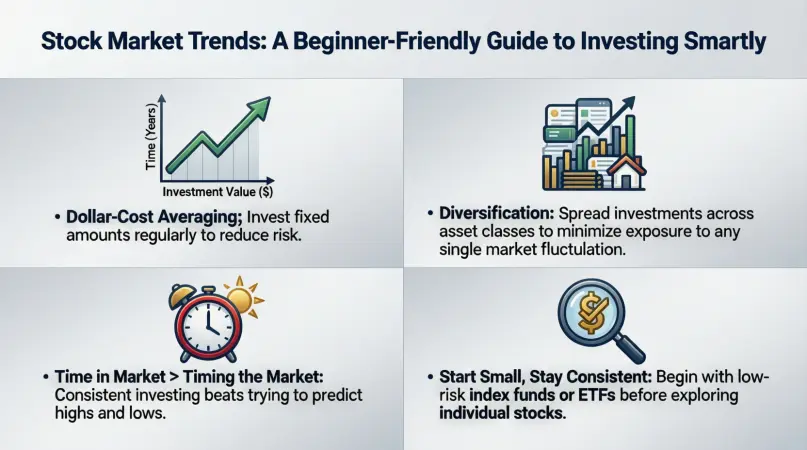
- Start Small – Begin with small investments to minimize risk.
- Keep Learning – Continuous education helps you adapt to changing market trends.
- Diversify Portfolio – Spread investments across sectors to reduce risk.
- Use Stop-Loss Orders – Protect your investments from sudden downturns.
- Avoid Overtrading – Stick to your plan and avoid frequent, emotion-driven trades.
- Stay Updated – Follow economic news, company reports, and global developments.
- Practice Patience – Trends may take time to fully develop; avoid rushing decisions.
- Track Your Progress – Keep a journal of trades, lessons, and outcomes to improve strategies.
Conclusion
Stock market trends are an essential tool for both beginners and intermediate investors. They provide guidance on market direction, help manage risks, and increase confidence in investing decisions. By understanding uptrends, downtrends, and sideways trends, investors can make smarter choices and optimize their portfolios.
While trends are powerful, they are not foolproof. Combining trend analysis with fundamental research, risk management, and disciplined strategies ensures a more successful investing journey. Avoid common mistakes such as overtrading, chasing trends, or relying solely on technical indicators. Instead, focus on continuous learning, patience, and staying updated with market developments.
Mastering stock market trends takes time and practice, but the rewards are significant. With the right approach, you can navigate the market confidently, seize profitable opportunities, and build long-term wealth. Remember, investing is a journey, and understanding trends is a critical step toward financial growth and security. Start small, stay disciplined, and let stock market trends guide you toward smarter investments.
